
01. Describe flow under operating conditions
“Thick product” is not a complete specification. Provide the product name, operating temperature, any viscosity measurement and its test conditions. Some non-Newtonian products can change apparent viscosity with the shear rate generated during pumping or mixing. Apparent viscosity is the viscosity under specified flow or measurement conditions; this behaviour does not apply to every liquid. Comparing measurements taken under different conditions can therefore be misleading.
- Particle size, concentration and sensitivity to damage, where relevant.
- Foaming, air entrainment, settling and behaviour after standing.
- Dripping or stringing as product separates from the nozzle.
- Compatibility information for product-contact materials and seals.
If viscosity is unknown, a sample and video of the existing filling process can support the initial assessment. Any necessary measurement or trial is then defined separately.
02. Compare dosing technologies for your product
First decide how to move the product, then how to control the delivered quantity. A suitable pump may transfer product while a weighing system controls the endpoint. Weighing is not itself a product-transfer mechanism.
A piston dosing pump draws product into a cylinder and discharges a defined volume through movement of its dosing piston. This is the product-contact dosing unit; the pneumatic or electric actuator driving it is a separate component. A piston filling machine is the complete system, including that unit, valves, nozzles and other required equipment.
In a rotary lobe pump, rotating lobed rotors carry product around the casing from inlet to outlet. In a progressive cavity pump, conveying cavities formed between a screw-shaped rotor and a stator progress towards the outlet.
| Pump / dosing unit | When to assess it | What to check |
|---|---|---|
| Piston dosing pump | Filling creams, sauces and similar products with volume metered through piston/cylinder movement. | Cylinder/stroke range, filling/refill cycle, valve passages and cleaning access. |
| Gear pump | Controlled transfer and dosing of compatible, pumpable products. | Particles and wear, shear sensitivity, sealing and calibration. |
| Rotary lobe pump | Product transfer and filling with an appropriate control arrangement. | Inlet conditions, particle passage, operating speed and quantity-control method. |
| Progressive cavity pump | Application-specific dosing of thick or shear-sensitive products. | Rotor/stator compatibility, inlet supply, cleaning and wear. |
| Peristaltic (hose/tube) pump | Suitable applications where a tube-only product-contact path is useful. | Model-specific viscosity/flow limits, tube restitution and life; calibration with the product. |
These are pump and dosing-unit options for a filling machine. Select quantity control, valves/nozzles and calibration together; pump type alone does not establish filling accuracy.
03. Select nozzles, product supply and cleaning together
How product reaches the pump and separates from the nozzle matters alongside pump choice. Hopper level, inlet arrangement, hose length, bore and restrictions can affect consistency. Particle-containing products also require a review of nozzle and valve passages.
Depending on the product, stringing may call for a shutoff nozzle, suck-back or a different filling-speed profile. Bottom-up filling may be assessed for foaming products where the container and process suit it. Heating or agitation is selected only where the product permits; neither is an automatic feature of every viscous filler.
Review removable parts, retained product, seal access and changeover frequency. State the cleaning and material requirements for the food, cosmetic or chemical application in the quotation scope.
04. Assess output using the complete cycle
Nozzle count alone does not establish hourly output. Review container loading, filling, nozzle shutoff, product separation, transfer and any closing operation together. If parallel nozzles share a product supply, total available flow must also support them.
Illustrative calculation only
A hypothetical arrangement filling four containers simultaneously with a complete 6-second cycle has an ideal output of 4 × 3,600 / 6 = 2,400 containers/hour.
This is not a QDM machine rating. Actual production changes with supply waits, stops, cleaning and connected operations. Recheck the cycle when fill quantity or product changes.
05. Check fill quantity with the actual product
Define “accurate filling” through a target quantity and permitted variation. Absolute and percentage error matter differently for small doses; one accuracy percentage should not be assumed to apply to every product and volume.
- Define the actual product, operating temperature, container and nozzle arrangement.
- Remove trapped air and establish consistent supply, then record an agreed number of consecutive fills.
- Tare the empty container and check net fill mass using a suitable balance. Converting mass to volume requires product density at the same temperature.
- Review average quantity, fill-to-fill variation, dripping and the complete cycle time together.
- Agree checks for startup, restart after a stop and different hopper levels.
Sample count, tolerance, measurement method and acceptance criteria are defined for the project.
06. Prepare these inputs for a quotation
- Product: name, sample, temperature and any viscosity measurement with its conditions.
- Flow behaviour: particles, foaming, air entrainment, dripping and stringing.
- Fill: minimum/maximum quantities, permitted variation and whether the requirement is mass or volume.
- Container: type, opening diameter, height and different formats.
- Production: hourly target, operating time and product/container changeover frequency.
- Automation: operator tasks and any feeding, capping, labelling or coding requirements.
- Cleaning and site: cleaning method, material requirements, layout and available power/air.
- Delivery: destination, preferred date, installation and verification scope.
Leave unknown values open and send the information you have, together with a process video. We can identify missing inputs during the initial review.
07. QDM project example and next step
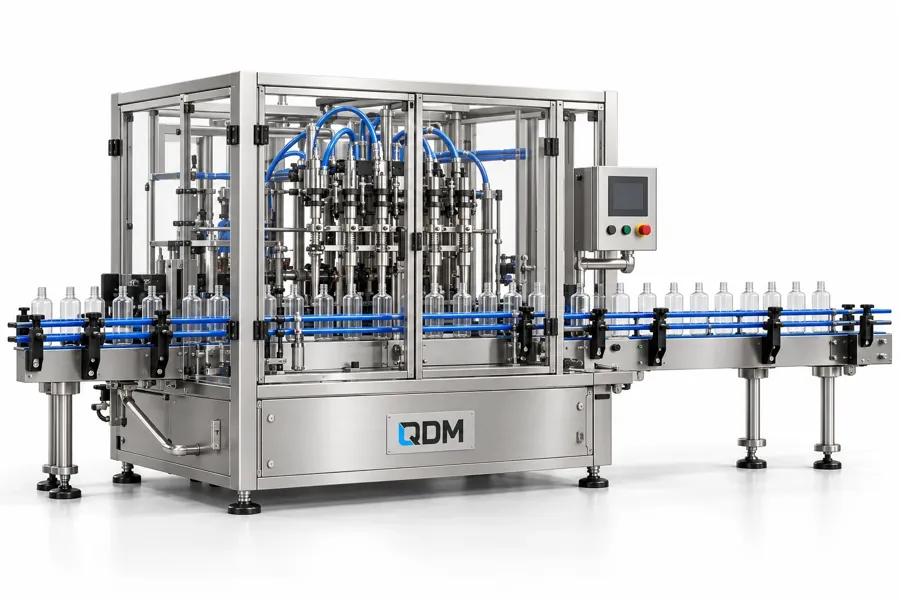
QDM’s delivered multi-nozzle liquid filling project addressed viscous products, low-volume dosing and the production workflow together. The same configuration or result should not be assumed for a different product.
08. Frequently asked questions
Can one machine fill honey, cream and gel?
It may be possible for an agreed product range. Review temperature, flow, seals, nozzles and cleaning together; trials may be needed for each product.
Does a viscous product always need a piston filler?
No. Piston, gear, lobe and progressive cavity options are assessed against the product and filling conditions. Certain peristaltic systems may also suit the application.
Is a sample required before a quotation?
Initial review can start with available information. If flow or filling performance is uncertain, plan a sample trial to clarify the technical scope.