
Compact Benchtop Orbital Shaker
Sample preparation, controlled shaking and small-scale product development on a laboratory bench.
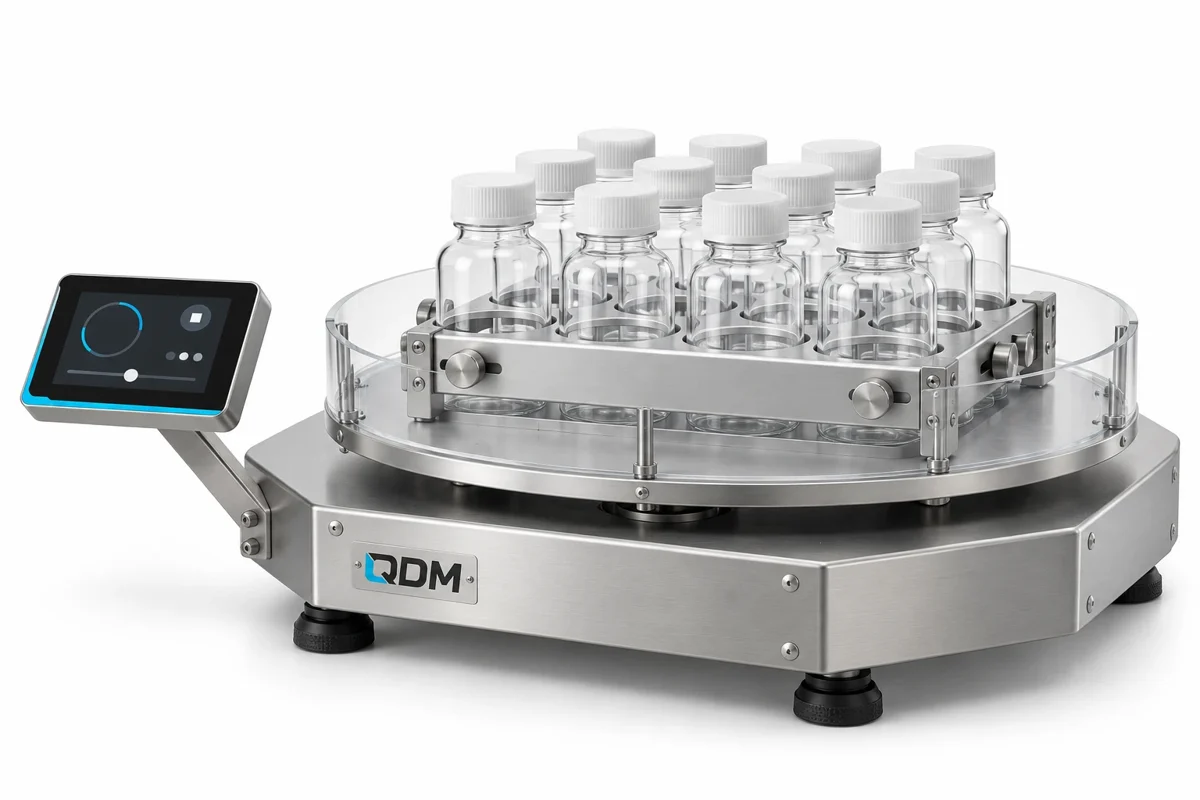
Key configurations
- Benchtop footprint
- Vessel-specific carriers and clamping plates
- Speed and time controls
- Configuration for bench rigidity and load distribution
Technical reference and configuration
| Motion | Orbital |
|---|---|
| Speed range | Project-specific |
| Total load | Project-specific |
| Vessel arrangement | Project-specific |
| Orbit diameter | Project-specific |
| Body | AISI 304 reference; material selected for application |
| Timer | Project-specific |
| Power supply | Project-specific |
| Platform and dimensions | Project-specific |
Concept design views. Bottle counts, display values and layouts in renders are illustrative. Technical values are reference design targets, verified with vessel type, fill volume, orbit diameter and load distribution.
Operating principle
In orbital motion, reference points on the platform follow a circular path. Vessel rotation and reciprocating rocking are different motion types. Motion geometry and orbit diameter are defined for the project.
Customisation options
- Adapters for vessel dimensions and geometry
- Platform size, carriers and clamping
- Orbit diameter, speed profile and balanced loading
- Control screen, timer, recipes and data logging
- Guards, lid interlocks, emergency stop and stopping behaviour
- Body material, finish, castors and anchoring
Vessel type, fill volume, sample properties, daily operating time and the process objective are evaluated together. Heating, cooling, incubation or pressure-vessel compatibility require a separate scope.