
Filling Machines
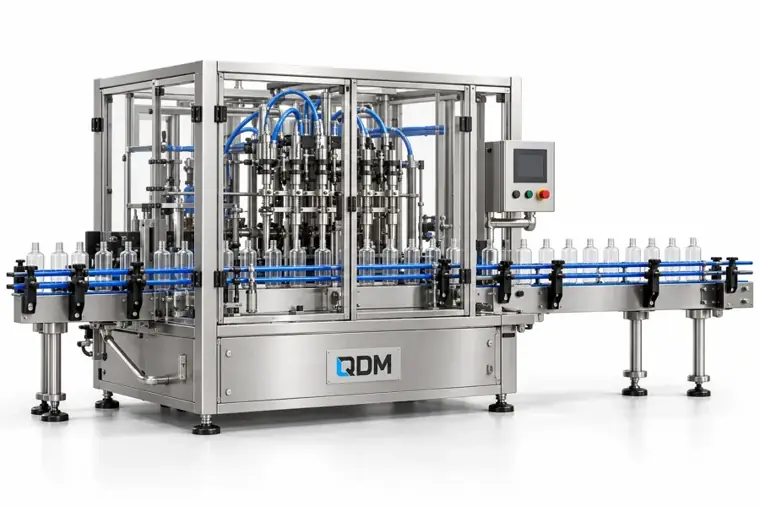
For your filling requirement, you can purchase a standard machine, develop a custom filling machine or add the necessary functions to an existing machine. QDM evaluates these three routes according to your needs. Liquid or fluid type, fill quantity, bottle type and production target guide the choice of manual, benchtop, linear or rotary arrangements.
Quick Design Makina · Updated: 14 October 2026
Initial assessment
| Option / topic | Requirement | Points to assess together |
|---|---|---|
| Manual / benchtop | Compact, operator-fed work | Positioning, dose adjustment and cleaning |
| Linear | Sequential conveyor stations | Bottle transfer and closing interfaces |
| Rotary | Cyclic operation with carriers | Bottle-specific fixtures, carriers and feeding |
Define the liquid or fluid to be filled
A water-like liquid, foaming cleaning liquid and thick sauce do not behave in the same way during filling. Temperature, particles, consistency and foaming tendency affect the filling method. State the fill quantity and acceptable variation as well. Pump, valves, hoses and nozzles are reviewed together; selection is not based solely on nozzle count.
How do manual, linear and rotary arrangements differ?
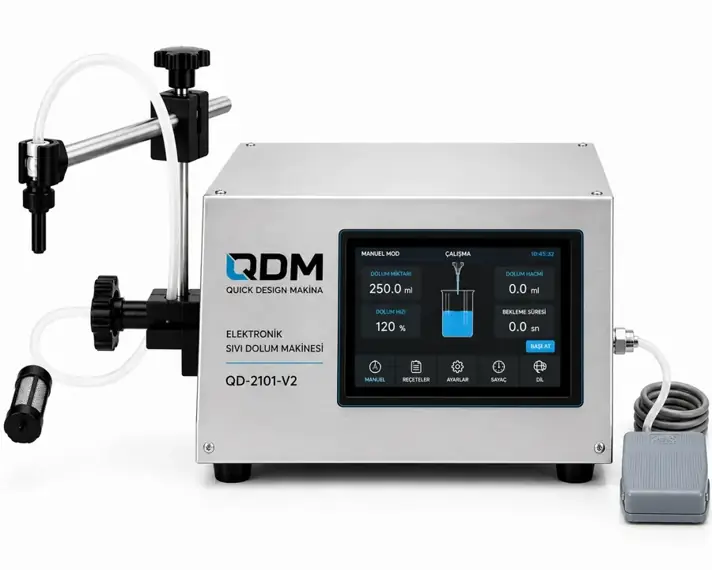
Manual and benchtop applications can be compact solutions where an operator positions the container. In a linear arrangement, containers travel between stations on a conveyor. In a rotary arrangement, carriers or pockets can combine filling and other operations within a rotating layout. These descriptions alone do not establish a speed ranking: container feeding, filling time and closing affect actual output.
Why do bottle changes and cleaning matter?
Running one bottle size and handling several bottle or container types require different arrangements. Bottle height, neck diameter, strength and how it is held are considered. Moving between sizes may require guides, fixtures or carriers to be adjusted or replaced. When changing the liquid, access to contact parts and the cleaning method must be planned. Material selection is reviewed with the actual fluid and cleaning conditions.
How should price and capacity be assessed?
Automation level, bottle and container variety, fill quantity, material choices and additional systems affect price. State cap feeding, cap tightening, labelling and coding requirements at the initial assessment. Discuss hourly capacity together with the conditions under which it will be verified using a specified fluid and container. Do not assume a catalogue maximum speed will be achieved in your filling application.
How can you start a filling project with QDM?
Start with fluid information, fill quantity, bottle type and dimensions, images of the current filling operation and target output. QDM can provide standard-machine research and purchasing coordination, custom machine design and manufacturing, or additions and development for an existing machine. Scope is defined around your needs, from manual and benchtop applications to lines combining filling, closing and handling. Trial samples and checking methods are agreed at this stage.
Frequently asked questions
Can thick fluids be filled on the same machine?
Some machines can be adapted to different liquids and fluids. Suitability is assessed through consistency, fill quantity and the parts in contact with the fluid.
How many nozzles should I choose?
Production target, filling time and container handling are considered together. More nozzles do not always increase capacity in the same proportion.
Can labelling be added to a filling line?
Yes, it can be considered with suitable layout and machine interfaces. Closing, labelling and coding should be defined as separate supply items.
Let us review your requirements.
Share the liquid or fluid, fill quantity, bottle or container dimensions and production target so we can assess a standard, custom or modified filling solution.
Contact us