
Custom Assembly Machines and Industrial Robotic Systems
Custom assembly machines for pressing, screwdriving, joining, handling and inspection. Review robotic cells and production-line applications according to the task.
Quick Design Makina · Updated: 14 October 2026
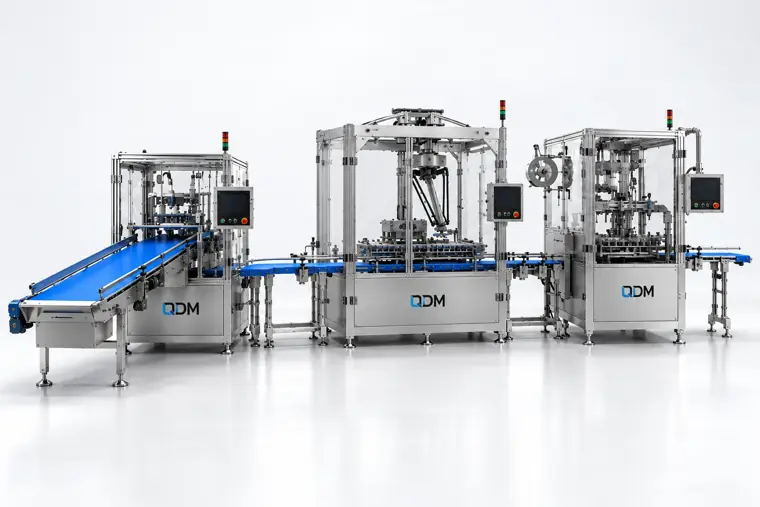
Initial assessment
| Option / topic | Requirement | Points to assess together |
|---|---|---|
| Manual assistance | Operator loading + mechanical support | Ergonomics and quality |
| Semi-automatic | Operator loading + automatic operation | Cycle and checks |
| Fully automatic | Automation from feeding to discharge | Product range and stations |
Review the operation sequence using actual parts
Explain where parts come from, how they are held and the sequence in which they are joined. Dimensional variation, different models and incorrect loading possibilities are assessed. A short video and part samples help initial design decisions. Understand the complete task before selecting a robot or press.
Choose semi-automatic or fully automatic operation
An operator-loaded station may suit some tasks. Automating feeding, orientation and unloading adds different investment and development needs. Product variety and target output are core inputs. A machine improving one step and an entire assembly line are not treated as the same scope.
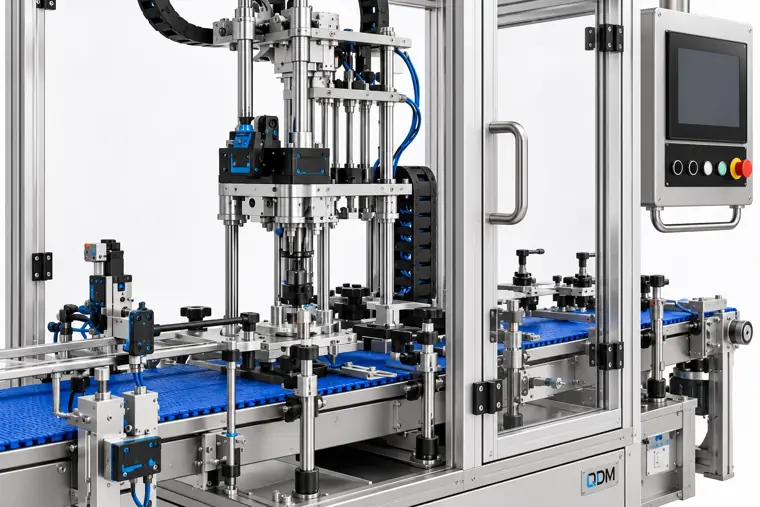
Develop fixtures and inspection together
A joining mechanism cannot be expected to perform reliably without correct part positioning. Reference surfaces, holding forces and tool access are reviewed in design. Define what must be checked after pressing or screwdriving. Part detection, cameras, measurement or testing can be included using suitable modules.
Assess industrial robotic systems around the task
Handling, feeding, picking and placing, assembly and inspection can be considered within a robotic cell. Robot selection is reviewed with part characteristics, reach, layout, cycle target and surrounding equipment. Grippers, fixtures, handling and controls interfaces belong to the same application. QDM can plan mechanical and automation scope with suitable project expertise.
Assess cycle time across the complete operation
The movement time of one mechanism does not explain the output of the complete assembly operation. Loading, joining, checking and unloading are considered together. Plan adjustments and fixture changes between products. Clearly state target times and acceptance conditions for trials using representative parts.
Which stages can be discussed with QDM?
QDM can develop assembly mechanisms, fixtures, handling arrangements and custom station designs. Prototyping, manufacturing, controls integration and commissioning are planned within project scope. DFM and DFA approaches consider part manufacturing and assembly arrangements together. Required production files and usage rights are stated at quotation stage.
Frequently asked questions
Is a robot necessary?
No. Mechanical transfer, pneumatic or other motion arrangements may be more suitable depending on the task. Selection is based on assembly requirements.
Can an existing manual assembly task be mechanised?
A feasibility assessment can be made by reviewing parts, operation sequence and quality expectations.
Can we start with one station and extend the line?
If expansion needs are stated early, interfaces and layout can be assessed accordingly.
Let us review your requirements.
Share the assembly video, part samples and production target so we can assess a suitable station or line arrangement.
Contact us